
Public Trust and Judicial Integrity: A Conversation with Judge David Tatel
The integrity of the courts does not depend on whether a judge believes himself to be objective, but on whether the public perceives him to be objective.
— The Hon. David S. Tatel (Ret.)
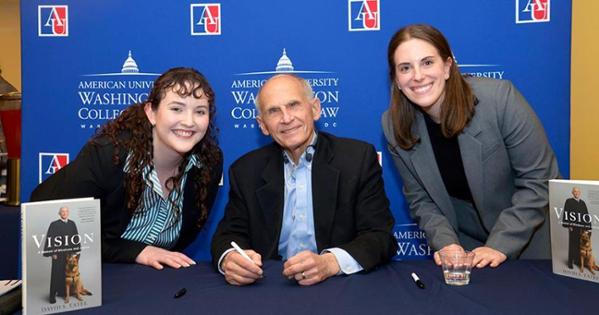
The Program on Law and Government at American University Washington College of Law (AUWCL) hosted a book discussion and signing this week featuring Judge David Tatel, who served on the United States Court of Appeals for the D.C. Circuit. The event, centered on his memoir, Vision: A Memoir of Blindness and Justice, highlighted Judge Tatel’s long career in the judiciary and the ways his blindness has shaped his life and work. Throughout the conversation, he spoke openly about the responsibilities that come with judicial power and the often unseen ethical decisions judges must make to preserve the legitimacy of the courts. The discussion, led by 3L students Abby Rubin and Rachel Bechtel, featured thoughtful audience Q&A and reflected the role of student leadership and civic dialogue in legal education.
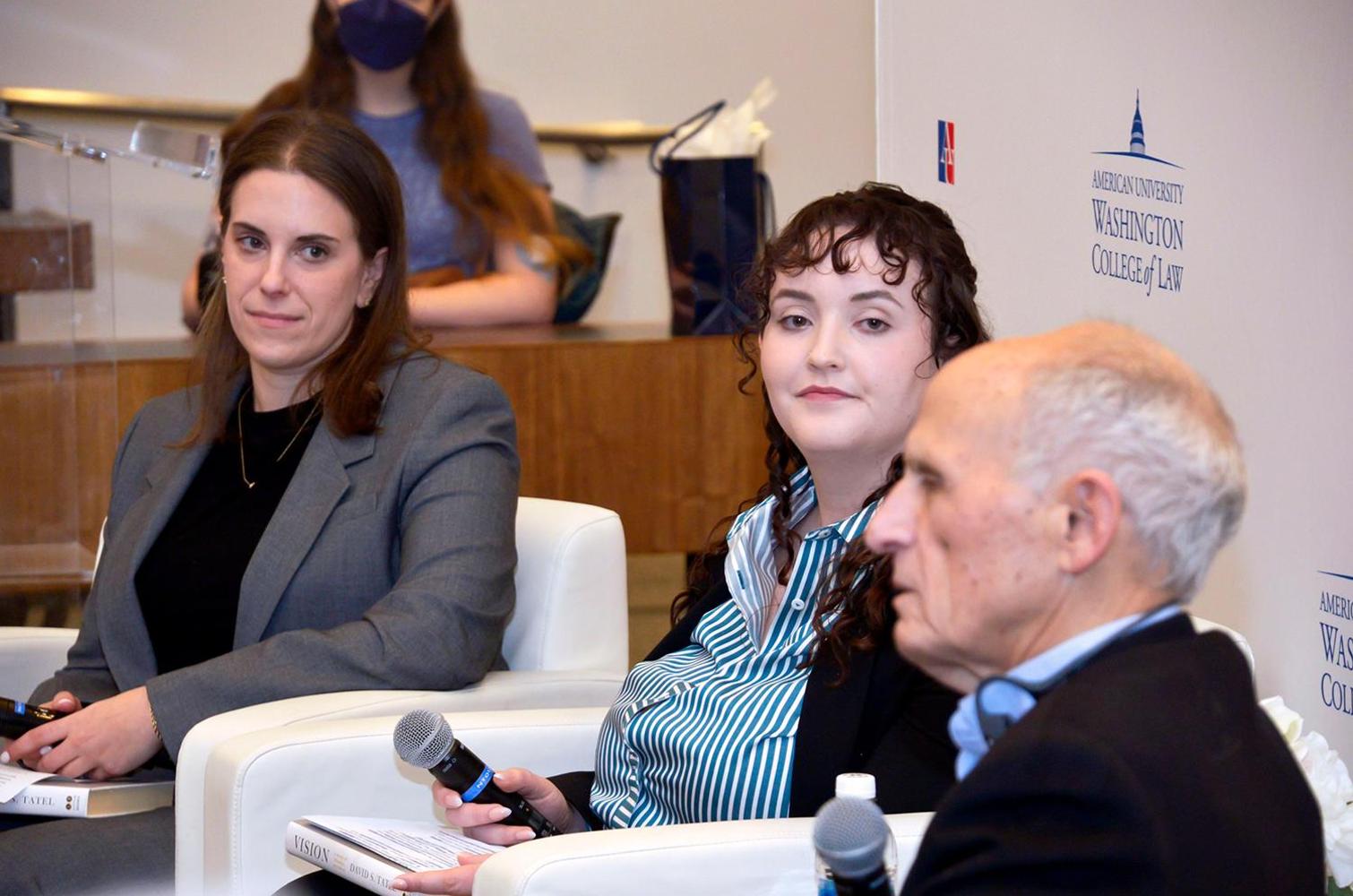
During the Q&A, a student asked Judge Tatel about a passage in his book describing his decision to recuse himself from a case involving the Americans with Disabilities Act and the U.S. Treasury’s compliance with it. Although Judge Tatel believed his blindness would not influence his application of the law or his judicial decision-making, and felt confident in his ability to remain objective, he ultimately chose to recuse himself. His reasoning was simple but profound: the judiciary has no enforcement mechanism of its own. It has no army or police force. Its authority rests entirely on public trust. That trust exists only if the public believes judges are impartial.
For Judge Tatel, preserving the judiciary’s integrity meant prioritizing how the public might perceive his participation, even when he personally believed his judgment would be unaffected. That commitment to institutional legitimacy over individual confidence offered a compelling lesson in judicial ethics, one that many students will carry with them as they pursue careers in law and public service.
 Students were moved by the judge’s candor and inspired by his story. Judge Tatel shared that he wrote his memoir to show young people that they truly can do anything. He reflected on the lack of blind role models during his own journey and expressed hope that he might now serve as that example for others.
Judge Tatel also emphasized that inspiration is a central reason a more diverse judiciary is essential. Diversity, he explained, is not about changing outcomes in cases, but about ensuring that young aspirants across the country can see themselves reflected in positions of power and believe that success is possible for anyone.
Judge Tatel’s message was clear: the strength of our institutions depends not only on the laws we write, but on the care, perception, and responsibility with which we uphold them. Seeing the room filled with engaged students and hearing the thoughtful questions that followed his remarks was a powerful reminder of why these conversations matter.

During the reception, students lined up to have their copies of Judge Tatel’s book signed, expressing their gratitude for the opportunity to learn from a jurist who exemplifies integrity, humility, and a deep respect for public trust.
The event was made possible through the collaboration of the Program on Law & Government, the Disability Law Society, the Fair Housing Law Society, the Office of Student Affairs, and AU’s Project on Civic Discourse.