
Michael Barry Brings Vision, Experience and a People-Centered Approach to AUWCL
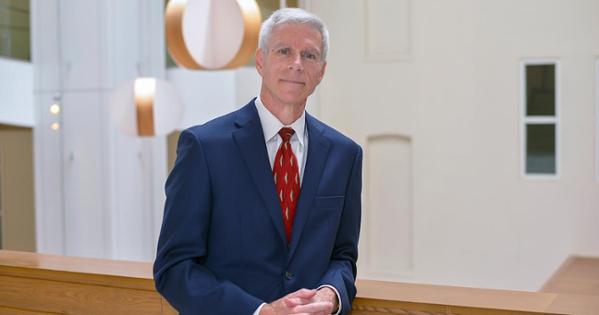
When Michael Barry talks about legal education, he does not begin with rankings, budgets or strategy — although he acknowledges each is important.
He begins with justice.
Long before he became a law school dean, corporate executive, litigator, and educator, Barry was a law student accompanying his father, an attorney and judge with the U.S. Coast Guard, to conferences and legal events. Those early experiences introduced him to the legal profession and the idea that the law could serve a larger purpose.
“I became enamored with the legal profession’s ability to foster justice,” Barry said.
That commitment to service, combined with a passion for debate and the intellectual challenge of advocacy, ultimately set him on a path that would lead him to American University Washington College of Law as its next dean.
Barry officially joined AUWCL on July 1, bringing decades of experience across legal practice, business leadership and academia. Most recently, he served as president and dean of South Texas College of Law Houston, where the school saw significant gains in bar passage and employment outcomes and launched an ABA-approved online part-time JD program.
Before entering academia, Barry built an extensive legal and business career that included complex litigation practice, leadership roles at Capital One and USAA, and clerkships with federal judges in Washington, D.C., and the Eleventh Circuit.
But Barry sees those experiences not as distinct roles, but as a journey that has informed his philosophy about leadership and education.
“I have been blessed to have been entrusted with a wide variety of responsibilities,” he said. “Those disparate experiences were foundational to my commitment to provide our law students an exceptional educational experience.”
For Barry, effective leadership means pairing mission with measurable results.
“Every successful organization has a clear mission and a strong strategic vision,” he said, “My responsibility is to help AUWCL deliver on its educational mission.”
That mindset is one reason AUWCL appealed to him.
“AUWCL is a great law school,” Barry said with unmistakable enthusiasm. “It has amazing educational programs. It has a dedicated scholarly faculty, a committed student body and successful alumni around the world.”
What excites him most, however, is the opportunity to elevate and expand the school’s national profile at a time when AUWCL continues to build momentum across its academic programs. The law school remains nationally recognized for its strengths in Clinical Training, International Law, Intellectual Property, and Part-Time Legal Education, while also seeing upward movement in areas such as Health Care Law and Environmental Law.
“My goal is very simple: to help AUWCL receive the recognition it deserves,” Barry explained.
Barry’s leadership philosophy is also deeply shaped by his upbringing. Raised in a Catholic family, he says the values of service, dignity and education were central to his early life.
“My grandfather was raised on an Irish pig farm in a two-bedroom home without indoor plumbing,” Barry said. “And here I am, two generations later. So, yes, I believe in the power of education.”
He later earned a master’s degree in theology from the University of San Francisco, an experience that further strengthened his belief in service-oriented leadership.
“All of us, and particularly those in leadership roles, have a responsibility to serve others and to ensure that all people are treated with dignity and respect,” he said.
As he looks toward AUWCL’s future, Barry believes law schools must balance tradition with innovation while remaining grounded in the enduring principles of democracy, equality and justice.
“Instilling these commitments in our students is more important than ever,” he said. “The law school is the means by which we ensure that future generations are equipped to preserve and protect the ideals we cherish.”
A strong supporter of experiential education, Barry says AUWCL’s nationally recognized clinical and advocacy programs are critical to preparing students for a rapidly evolving profession.
“In a world in which technology performs an ever-increasing portion of the tasks attorneys now do, relationships and experiences become even more valuable,” Barry noted. “Our expertise in experiential education distinguishes us and separates us from other law schools.”
He also believes the next generation of lawyers must develop not only technical knowledge, but also adaptability, empathy, creativity and problem-solving skills.
“Nobody calls an attorney because they want to,” Barry said. “They call an attorney because they have to. They have a problem that needs to be addressed or an opportunity they want to seize. The attorney is the problem solver.”
That same people-centered philosophy extends to alumni engagement.
“I look forward to meeting with our alumni,” Barry added. “Their engagement and support will be crucial to the law school’s continued success, and I want to invite them to be part of our community in a new way.”
He sees alumni not simply as supporters, but as essential partners in the life of the law school through mentoring, hiring students, participating on campus, and helping shape AUWCL’s future.
“I want our graduates to be proud of what we are accomplishing,” he said.
Outside of his professional life, Barry is an avid runner who has completed a marathon in under four hours in all 50 states, an accomplishment achieved by fewer than 200 members of the specialized “50Sub4” running community. The distinction reflects not only endurance, but also consistency, discipline, and long-term commitment — qualities that also help define his leadership style.
As he settles into this new chapter at AUWCL, Barry says success will ultimately depend on a shared commitment across the entire community.
“If we are able to be bold,” he said, “there is tremendous opportunity ahead for AUWCL.”