WTO Director General Delivers the 2026 Wenger Lecture on International Trade to Standing-Room-Only Crowd at AUWCL
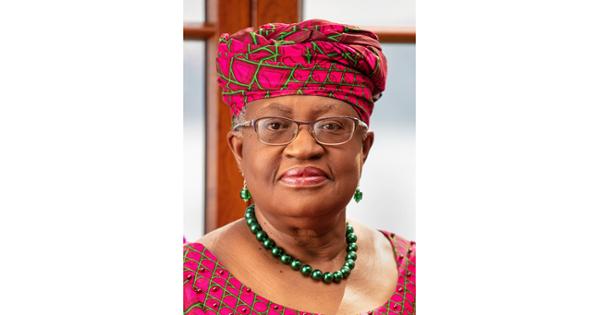
World Trade Organization Director General Dr. Ngozi Okonjo-Iweala delivered the 2026 Wenger Lecture on International Trade entitled: “Global Trade, Overdependencies and the Future of the Multilateral Trading System”. to American University Washington College of Law on April 15. The keynote concluded a full day conference entitled: “Reimagining Multilateralism for the Future.”
WTO Director General was introduced by American University President John Alger, Law School Dean Heather Hughes and Director of the Trade, Investment and Development Program at AUWCL, Professor Padideh Ala’i.

The packed Ceremonial Classroom drew students, faculty, legal practitioners, and policy experts. The lecture was followed by a discussion answering questions from the audience, moderated by Angela Paolini Ellard, Senior Advisor at the Center for Strategic and International Studies (CSIS) and former Deputy Director-General of the WTO.
The conference was organized by AUWCL’s Trade, Investment and Development Program and made possible by the Henry E. & Consuelo S. Wenger Foundation.
The Wenger Lecture capped a full day of expert panels examining the future of the multilateral trading system, U.S. perspectives on trade, artificial intelligence’s impact on global commerce, and the competition for critical minerals.
“As a lawyer and someone who believes in the rule of law, it's inspiring and encouraging to see all of you in this room today.” Alger said. “I love this theme of reimagining multilateralism for the future. That sounds like there is a future for multilateralism… and that’s encouraging.”
“As someone who has taught law of the WTO for almost three decades, I am very well aware of the weaknesses of the system and how the assumptions that underpinned the system are being fundamentally challenged,” said Ala’i. “We should not be afraid of challenging our assumptions. That is why we as academic institutions must try to “reimagine” what the system should look like, today, not what it was in 1947 or in 1994.”

“It is an honor and a privilege to have you here, Dr. Okonjo-Iwela,” Alger continued. “Thank you for your leadership over all of these years, and for giving us hope and encouragement for this important work going forward."
Dr. Okonjo-Iweala’s speech centered on what she called “global trade over-dependencies and the future of the multilateral trading system.” She opened with a blunt assessment of where things stand: “It’s the understatement of the century that the global trading system is experiencing the worst disruptions in the past 80 years.”
She pointed to longstanding frustrations within the WTO membership, including complaints about an uneven playing field and lack of transparency around subsidies, and developing nations’ concerns about inadequate policy space and their marginal share of global commerce.
“The fact is that most of these complaints and criticisms are valid,” she argued, adding that WTO members’ collective failure to update the global trade rulebook has fueled the unilateralism the world is now seeing.
Dr. Okonjo-Iweala also took stock of how the COVID-19 pandemic exposed the structural fragilities of global supply chains, from over-reliance on China for rare earths and semiconductors to just ten countries controlling more than 80% of global vaccine exports.
“The global trading system was designed for interdependence, not overdependence,” she said.

Looking at physical chokepoints, Okonjo-Iweala pointed to the ongoing crisis in the Strait of Hormuz, triggered by the Iran War, as a stark reminder of how geography can upend global commerce. “The crisis in the Strait of Hormuz has upended a large share of global trade in energy, fertilizer, and vital chemical inputs for semiconductors and other key goods,” she said, noting that the disruption has caused price spikes and export restrictions with major implications for global food security.
Despite the challenges, she pushed back against pessimism, arguing that the multilateral system has demonstrated real adaptability. Global goods trade volumes expanded 4.6% in 2025, she noted, outpacing GDP growth, with services trade growing even faster at 5.3%. “Even amid the tariff actions of the past year, the evidence is that supply chains have remained resilient and are rewiring,” she said.
She maintained the path forward lies in what WTO Secretariat economists have called “re-globalization”; diversifying trading partners, drawing in regions long left on the margins of global commerce, and building new rules capable of supporting digital and green trade. “How do we build resilience into robustness?” she asked. “What more do we have to do with our supply chains and our trade rules and policies to ensure continued predictability, stability, and reliability of the global trading system?”
Okonjo-Iweala gave a detailed account of the WTO’s recent 14th Ministerial Conference in Yaounde, Cameroon.

“We worked our tails off,” she said of the four days of around-the-clock negotiations. “We got close to our main objectives. But we ran out of time to complete the package.” Work is continuing in Geneva, she added, with no fixed deadline. “I want to modernize and rebuild a global trading system that is stable, predictable, fair and transparent... This new system would be more flexible, agile, and responsive.”
“You can term me naive, my friends,” Okonjo-Iweala said. “But I’m cautiously optimistic.”
For the students, practitioners, and policymakers who packed the Ceremonial Classroom, Okonjo-Iweala's message was clear. The system is flawed, the challenges are real, and the work is ongoing. But walking away from the table is not the answer.