
Breaking New Ground in Human Rights Litigation

For more than a decade, justice has been stalled in two critical human rights cases before the Inter-American Commission on Human Rights (IACHR). Now, a team of AUWCL Impact Litigation Fellows is using a newly established expedited procedure to fast-track a ruling for a Panamanian woman and the family of a young Mexican man.
In June 2025, students from the Impact Litigation Fellows Program (ILFP) at the AUWCL Center for Human Rights and Humanitarian Law—supervised by Dean of the Faculty of the Center Claudio Grossman and Assistant Director to the Program Marta Treviño-Leyva—submitted requests under the IACHR’s new expedited merits procedure (Resolution 4/23). This mechanism allows petitioners to fast-track long-pending cases if certain criteria are met.
The ILFP is an educational initiative that immerses students in strategic human rights litigation before international bodies. The fellows work on active cases to gain real-world legal experience in documenting human rights violations, promoting government accountability, raising public awareness, and contributing to litigation and advocacy strategies. The cases represent a unique opportunity to shape international legal standards and foster legal reforms in countries concerned and broader regions as well. The aim of such strategic litigation is thus not only to achieve justice for a particular victim of human rights violation, but to prompt structural changes or fill gaps in available protection.
The 2024/2025 Impact Litigation Fellows, Amelia Tenant JD ’26, Mikaela Read JD ’26, and Zuzana Pavlíčková, 2024-2025 Hubert H. Humphrey Fellow, have been working on cases concerning human rights violations in Cuba, Mexico and Panama, requesting expedited rulings in two of them.
Ana Matilde Gómez v. Panamá (Case 13.678)
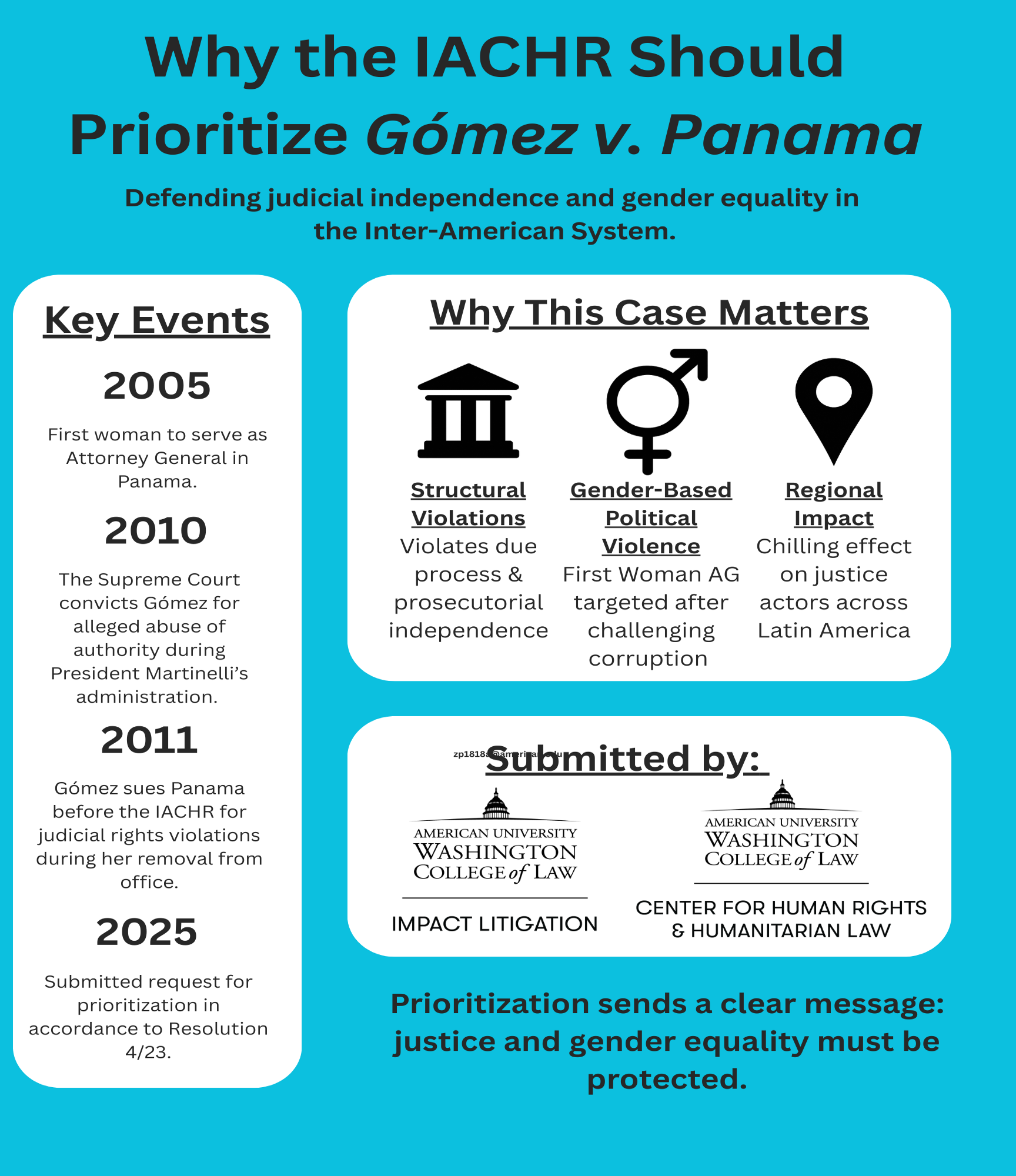
The petitioners argue that the former Attorney General of Panama, Ms. Ana Matilde Gómez, was wrongfully prosecuted and removed from office in 2010, violating her human rights due to a Supreme Court ruling that lacked due process. For 14 years, she has endured professional, reputational, and financial damage, alongside other personal harm and exclusion from public life. Her unresolved conviction also led to the State withdrawing her 2021 nomination to the Inter-American Court of Human Rights. This case exemplifies patterns of political retaliation, institutional instability, and gender-based exclusion within Panama’s justice system.
The ILFP team asserts that the case meets the urgent criteria under Resolution 4/23, allowing the IACHR to expedite merits decisions, given the risk of irreparable harm, structural failures, and its potential to influence regional human rights standards. Enforcing a politically motivated conviction against Ms. Gómez threatens her well-being and perpetuates gender-based political violence on the continent. Her case highlights how legal systems can be weaponized against women in authority, especially when challenging political interests. The team argues that this case offers an opportunity to enhance Inter-American standards on prosecutorial independence, foster institutional reforms, and reinforce the IACHR's commitment to gender equality and the rule of law.
Braulio Paredes Núñez v. Mexico (Case 13.237)
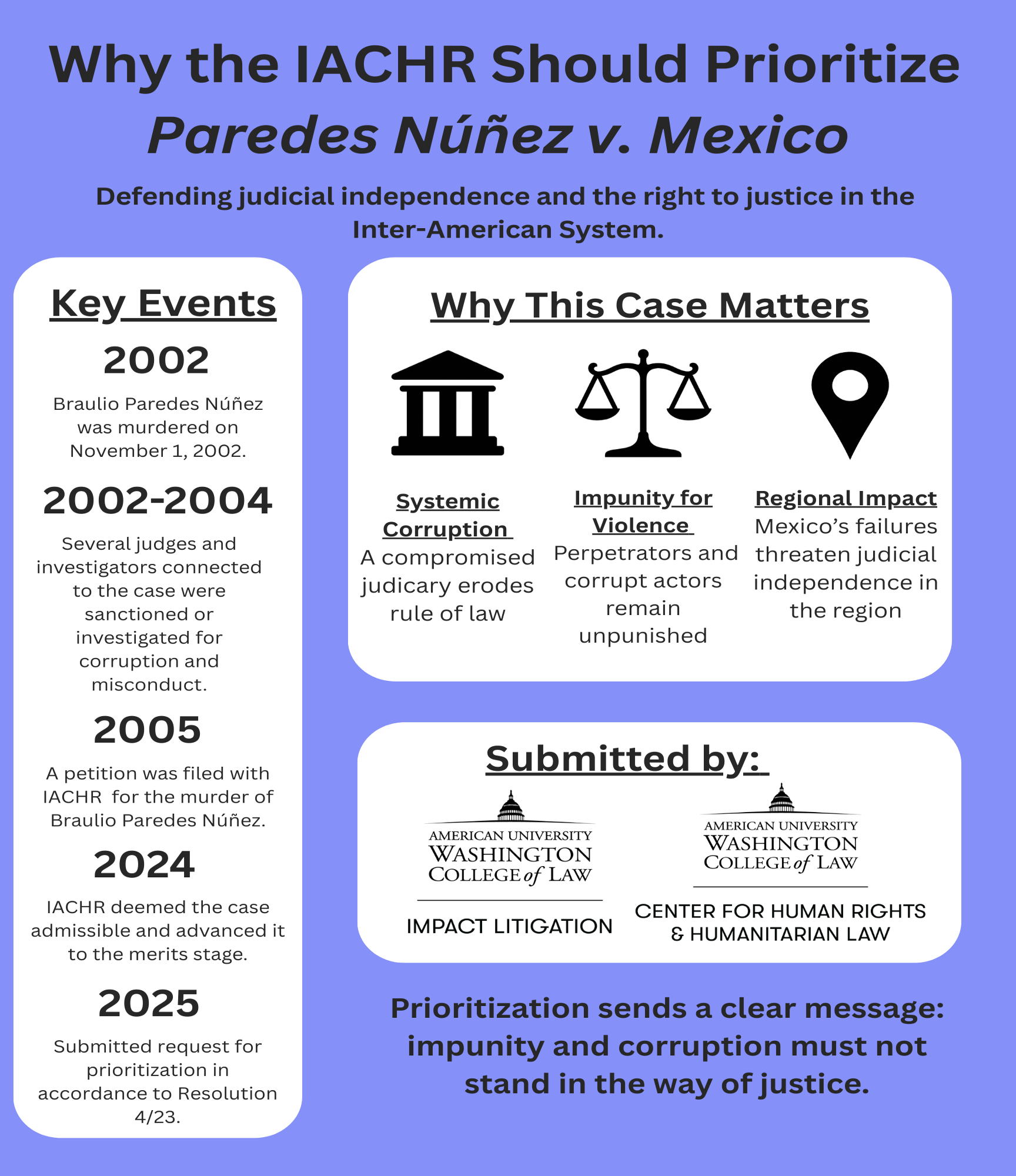
The case concerns the 2003 murder of 18-year-old Braulio Paredes Núñez, killed by the son of a prominent businessman. Several teenagers and two bodyguards were involved in concealing the crime. Despite compelling evidence, all suspects were acquitted due to investigative inconsistencies, missing judicial records, changing witness testimonies, lost evidence, and police bribery. After the acquittal, numerous judges and investigators faced sanctions for corruption and misconduct, yet no justice has been delivered to the victim's family.
Initially filed in 2005 and deemed admissible in 2024, the case still awaits a decision on its merits. ILFP fellows argue for its prioritization, as a verdict would advance Inter-American jurisprudence on judicial independence, corruption, and due process, highlighting severe issues within Mexico's judicial system. The ongoing lack of judicial independence threatens human rights in Mexico and is a broader regional concern, especially considering recent judicial elections. The evidence of misconduct in Braulio's case reflects systemic corruption and criminal impunity, presenting the IACHR with an opportunity to address these critical issues amid ongoing judicial reforms in the region.
Apart from these cases, ILFP fellows have also been preparing litigation and advocacy strategies for a case against Cuba, which has already been decided on merits, but the State still fails to fulfill recommended measures.
Lorenzo Enrique Copello Castillo y Otros v. Cuba (Case 12.477)
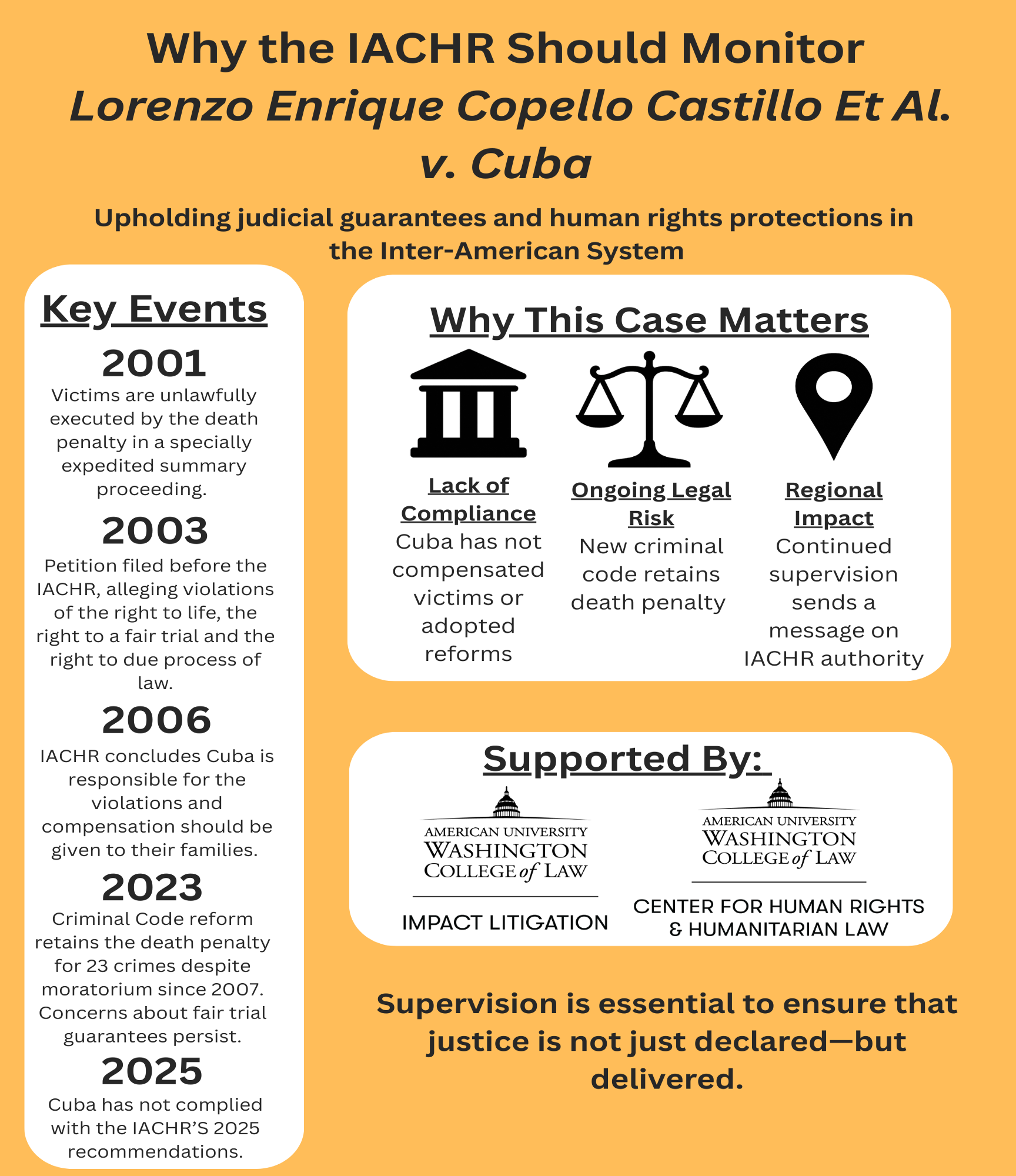


Three Cuban citizens were executed in 2003 following a hijacking attempt of a passenger ferry. Despite a national moratorium on the death penalty, the accused were subjected to an expedited summary trial for acts of terrorism against Cuba and sentenced to death within two weeks – Cuba´s last known executions to date. The case was declared admissible by IACHR, which concluded in 2006 that Cuba had violated Articles XVII and XXVI of the American Declaration by not providing the accused with a fair trial. The merits decision is under supervision, since Cuba fails to fulfil the recommendations addressed and pay reparations to families of the victims.
All cases demonstrate the importance of strategic litigation in international human rights law and at the same time show barriers that individuals still face in getting timely access to justice when they become victims of human rights violations.
The ILFP plays a crucial role in advancing human rights and seeking justice for victims of human rights violations in the American Continent and worldwide. The dedication and hard work of the Impact Litigation Fellows, staff and faculty exemplify the program's commitment to fostering accountability and strengthening human rights.
For more information visit the Impact Litigation website or contact Assistant Director Marta Treviño-Leyva at il@wcl.american.edu.