
AUWCL’s War Crimes Research Office Marks 30 Years of International Justice
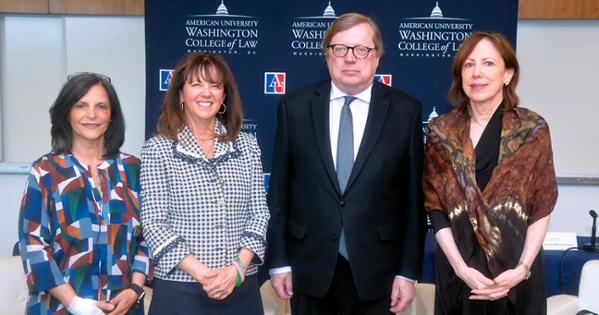
The War Crimes Research Office (WCRO) at American University Washington College of Law (AUWCL) marked a powerful milestone this week, celebrating 30 years at the forefront of international justice with a dynamic global gathering that reflected both its legacy and its lasting impact. For more than three decades, the WCRO has helped shape the evolution of international criminal law, supported accountability efforts around the world, and prepared generations of students to take on some of the most pressing human rights challenges of our time.
The WCRO was founded at a pivotal moment in global affairs. In the early 1990s, the horrors of the Bosnian War and the Rwandan genocide shocked the international community into action, prompting the United Nations Security Council to create new international war crimes tribunals for the first time since Nuremberg and Tokyo.
“The U.N. Security Council did something it hadn’t done before — it created a war crimes tribunal,” recalled Diane Orentlicher, faculty founder of the WCRO.
The WCRO was established in 1995 to support that work, providing rigorous legal research and analysis to the fledgling institutions of international justice.
“It was the first trial since Nuremberg and Tokyo prosecuting war crimes, genocide, and crimes against humanity, and they came to us for support for rigorous legal research and analysis,” said Susana SáCouto, director of the WCRO.
What began as a one-year project has grown into one of the most distinctive offices of its kind in the world.
“To my knowledge, there is no real equivalent of the War Crimes Research Office anywhere else in the world,” said Aryeh Neier, former president of the Open Society Foundations. “It has greatly enhanced the entire process of holding accountable those who are responsible for the commission of such crimes.”
Over the past three decades, the WCRO has contributed to the work of international tribunals and courts, supported accountability efforts across multiple continents, and helped shape legal frameworks that continue to influence the prosecution of war crimes, genocide, and crimes against humanity.
Its model, which integrates rigorous legal research with opportunities for students to engage in real-world accountability projects, has become a hallmark of experiential legal education and a defining feature of AUWCL’s global reputation.
That legacy and continued influence were on full display at a landmark event, co-sponsored by the International Commission of Jurists. The two-day symposium brought together scholars, practitioners, alumni, students, and advocates from across the globe not only to reflect on the arc of international justice, but also to recognize the WCRO’s enduring contributions to the development and enforcement of international criminal law.
The discussion featured Leila Sadat, James Carr Professor of International Criminal Law and director of the Whitney R. Harris World Law Institute at Washington University School of Law; and David Scheffer, former U.S. ambassador-at-large for war crimes issues. The conversation was moderated by AUWCL Professor Emerita Diane Orentlicher.
Speakers across both days acknowledged that the WCRO’s work is as urgent as ever, and perhaps more so.
Richard Goldstone, first chief prosecutor of the U.N. Criminal Tribunal for the former Yugoslavia and Rwanda, noted the significance of the WCRO’s 30th anniversary.
“We are presently at a point when international law is being largely ignored by powerful states,” he said. “The work of international courts and international lawyers becomes all the more important.”
Throughout both days, a common thread ran through every discussion: the transformative role the WCRO has played in the careers of the more than 1,500 students who have passed through its doors.
“My time at the War Crimes Research Office was really incredibly formative,” said Christian De Vos ’07. “What stands out to me is the combination of rigorous legal research with work that had clear real-world relevance.”
For many students, the WCRO is the reason they chose AUWCL in the first place.
“It was the number one reason I even applied to the school,” said Naziha Kabbani, a current AUWCL student. “Even being here, I’m just blown away every day.”
The office has long distinguished itself by taking students directly to the institutions they study.
As part of Summer Law Program in The Hague, the WCRO takes students “to the International Court of Justice, to the International Criminal Court,” SaCouto explained. “They get exposed to not just the doctrine, but the practice.”
That hands-on philosophy has produced a global alumni network with reach across every region. Former students are now working at international tribunals, human rights organizations, and governments around the world.
“While I was in The Hague interning at the ICTY, it was all the Ivy Leagues and then AUWCL, and everyone knew the reputation of the office,” recalled Vy Nguyen ’15, a WCRO alumni council member.
“I think the 30-year anniversary is really something remarkable. It reflects both the longevity of the office itself, but also the evolution of the field of international criminal justice, which has grown and changed tremendously in that period of time.”
For students in attendance, the message was clear: The work doesn’t end here.
“The biggest way to say thank you is to put it forward,” said Kabanni. “It’s to keep working in the field and making advances. Because international law does still have advances to make. Every one of us and all of our professors are working to make strides in that field.”
Built on a foundation of rigorous scholarship, real-world practice, and a global community of advocates, the War Crimes Research Office enters its next chapter with the same conviction that launched it: that accountability matters, that the law can be made to answer for the worst of human conduct, and that the next generation of practitioners will be the ones to prove it.
The work continues.