
A Living Legacy of Feminist Legal Thought
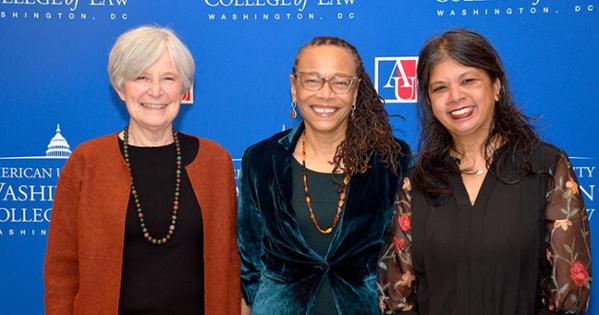
American University Washington College of Law marked a defining moment in feminist legal scholarship with the launch of the Inaugural Ann Shalleck Lecture, hosted by the Program on Gender, Theory, Law & Practice. The event featured Professor Dorothy E. Roberts, a 2024 MacArthur Fellow and George A. Weiss University Professor of Law and Sociology at the University of Pennsylvania, whose remarks powerfully examined the intersections of race, gender, and the law.
Honoring a Pioneer
The lecture series was established to honor Professor Emerita Ann Shalleck, a foundational figure at AUWCL. In her opening remarks, Professor Anita Sinha, faculty director of the Program on Gender, Theory, Law & Practice, traced AUWCL’s unique history. Founded 130 years ago by Ellen Spencer Mussey and Emma Gillett, Washington College of Law was the first law school in the country established by and for women. Professor Sinha candidly addressed the institution's complicated past, noting that for much of its history, the school’s mission was focused on white women to the exclusion of African American students.
Professor Shalleck helped reimagine how law could be taught by inserting feminist pedagogy into legal teaching. She urged law to be taught through lived experiences, not just doctrine, and emphasized the importance of centering marginalized perspectives in legal pedagogy, especially women affected by intersecting systems of oppression.
Professor Shalleck founded the Women & the Law Program in 1984, building on the founding history of AUWCL and representing the first law school program in the country dedicated to feminist legal theory and practice.
Turning the Lens Inward
Professor Roberts, known for her systemic critiques in books like Killing the Black Body and Torn Apart, used the lecture to discuss her most personal work to date: The Mixed Marriage Project: A Memoir of Love, Race, and Family.
The memoir was sparked by a discovery in her father’s archive—thousands of interviews he conducted in the 1930s with interracial couples in Chicago. Roberts described finding these “yellow papers held together with rusty staples,” which chronicled the lives of couples navigating a society where their very existence was often seen as a radical act.
“My father believed that interracial marriage was the answer to racism in America,” Roberts shared. Through her research, however, she uncovered a more complex reality. She found that while these couples sought refuge in their private lives, they often reproduced the same racial and gender hierarchies they were ostensibly challenging. Roberts noted that marriages between white women and Black men were often revered within their circles, while those between Black women and white men were frequently disparaged—a reflection of how “gender mattered as much as race” in shaping social legitimacy.
A Call for Reconciliation and Repair
Throughout the lecture, Roberts connected these historical archives to contemporary struggles against “family policing” and systemic inequality. She described her memoir as an “act of remembrance and repair,” echoing the praise of author Michelle Alexander.
The event served not only as a scholarly lecture but as a symbolic “passing of the torch” to a new generation of legal minds. Roberts, who announced her upcoming retirement to focus on writing full-time, emphasized the necessity of teaching law through the lens of those affected by it.
As the inaugural lecture concluded, the message was clear: understanding the law requires more than studying doctrine; it requires an honest accounting of our history and a commitment to transforming the systems that maintain inequality.