
A Global Platform for International Law: AUWCL Continues Its Grotius Lecture Legacy
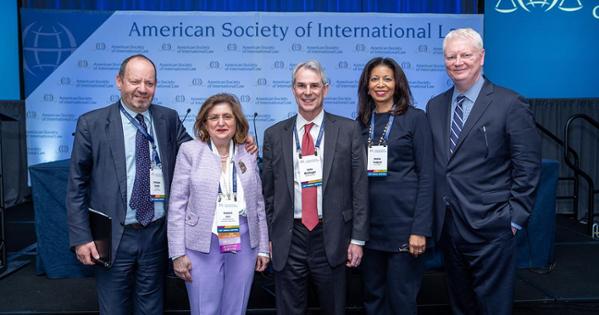
For nearly three decades, American University Washington College of Law has played a central role in shaping one of the most important public conversations in international law. Through its sponsorship of the Annual Grotius Lecture, held during the American Society of International Law Annual Meeting, AUWCL has helped ensure that the field’s most pressing issues are not only debated among experts, but shared more broadly with the public.
Established in 1999, the Grotius Lecture is a signature event of the Annual Meeting, traditionally opening the conference and featuring leading international law scholars and practitioners. Over time, it has become a widely recognized platform for advancing public understanding of international law, with AUWCL serving as a committed sponsor for almost three decades.
The Grotius Lecture holds a unique place within the ASIL Annual Meeting. Padideh Ala’i, professor of law and director of International and Comparative Legal Studies at AUWCL, and member of the organizing committee of the 2026 Annual Meeting, noted in her introduction that the lecture was designed as a public forum to expand engagement beyond traditional audiences and to elevate voices that might not otherwise be heard.
“Our long-standing partnership supporting the Grotius Lecture reflects our commitment to an expansive view of the role of society and the shared human values that animate international law,” Ala’i said.
That tradition continued with the 2026 Grotius Lecture, “Ruptures, Justice and Order,” delivered by Philippe Sands, KC, professor of law at University College London, visiting professor of law at Harvard, and practicing barrister at 11KBW with distinguished discussant John Bellinger, partner at Arnold & Porter and former Legal Adviser to the U.S. Department of State. The program opened with welcoming remarks from American Society of International Law President Melida Hodgson, setting the stage for an evening of reflection and global perspective. Speaking to a diverse audience of scholars, practitioners, and policymakers, Sands explored the profound challenges facing the international legal framework while underscoring its continued relevance in an increasingly complex world.
Sands described the current moment as a “rupture” with significant implications for alliances, institutions, and the future direction of international law. At the same time, he challenged the idea that the world is entering a lawless era.
“A lawless world is not a world without law,” he said, emphasizing that the continued invocation of international legal norms demonstrates their enduring legitimacy and function.
He noted that while some rules are being strained or violated, the vast majority of international law continues to operate effectively, shaping everything from global cooperation to daily life. Rather than signaling collapse, he suggested, today’s tensions reflect a familiar pattern of disruption followed by adaptation and renewal.
In his response, John Bellinger upheld that perspective, pointing to the continued strength of foundational principles such as the prohibition on the use of force under the United Nations Charter. While acknowledging recent challenges, he emphasized that these developments should prompt renewed efforts to strengthen and modernize international legal institutions.
Watch the lecture here.
See the event photo gallery here.