

Criteria for the Evaluation of Candidates to IAHRS Bodies
High moral character and high moral authority
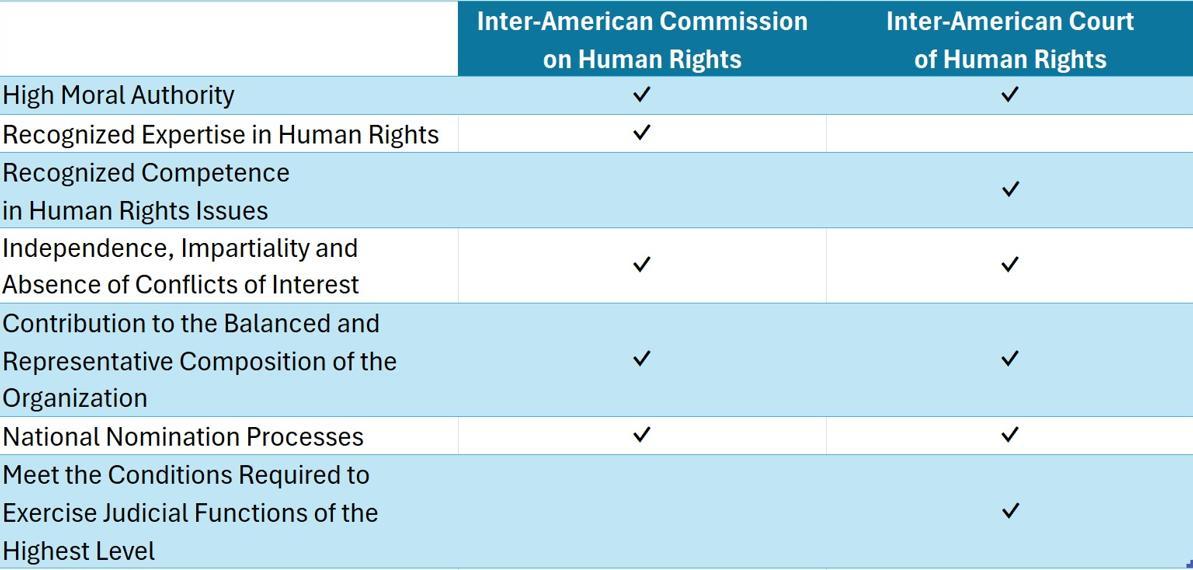
The American Convention on Human Rights (ACHR) establishes high moral authority as one of the requirements for being a member of both the IACHR and the IACtHR. In relation to the former, it specifies that the commissioners must be “persons of high moral character and recognized competence in human rights” (Article 34 ACHR). On the other hand, regarding the requirements to serve as a judge, it is required that they be “jurists of the highest moral authority and of recognized competence in the field of human rights, who possess the qualifications required for the exercise of the highest judicial functions in conformity with the law of the State of which they are nationals or of the State proposing them as candidates” (Article 52 ACHR).
In previous reports, the Panel has commented on this requirement by referencing the Bangalore Principles, which develop values of integrity and propriety. In this regard, the requirement entails ensuring that the individual’s conduct is free of reproach under the criterion of a reasonable observer.
The Bangalore Principles link this value to public trust and the importance of making just decisions through transparent processes. In this sense, misconduct and the appearance of misconduct should be avoided in all activities.
Under this understanding, the Panel has examined aspects of candidates concerning:
- The record of sanctions, offenses, or complaints in their professional practice that may affect the ethics of the person’s functions;
- Special mentions, recognition, distinctions, or awards that attest to the person’s high moral authority (Final Report 2019).
In particular cases where there is information linking a candidate to unethical practices, the Panel evaluates the sources of information, analyzes whether the accusations are serious and substantiated, and then issues a conclusion.
Additionally, the IACtHR Statute lists some incompatibilities with the position of judge, including: being members of the Executive Branch (except for those who hold positions that do not place them under the direct control of the Executive Branch, as well as diplomatic agents who are not Chiefs of Missions to the OAS or any of its Member States); being officials of international organizations, or holding any other position or activity that prevents judges from discharging their duties or affects their independence, impartiality, dignity, or prestige (Article 18 IACtHR Statute).
Recognized expertise and recognized competence in human rights
In the case of the IACHR, the ACHR establishes as a necessary requirement “recognized expertise in human rights,” while in the case of the IACtHR, the ACHR requires “recognized competence in human rights.”
In the first case, the Panel has indicated in previous reports that “recognized expertise in human rights” implies both knowledge and demonstrated experience in the field of human rights, meaning familiarity with inter-American human rights instruments, mastery of the main standards issued by the bodies of the Inter-American Human Rights System (IAHRS), understanding the internal procedures and the relationships of the IAHRS with external actors, and comprehending its dynamics of operation, among others. It is key that the candidate is familiar with and has experience in the IAHRS, as evidenced by a history of professional achievements, academic publications, or substantial work or litigation experience in the system (Final Reports 2017 and 2018). Additionally, the Panel analyzes the candidate’s knowledge of the main challenges facing the IAHRS, their proposals and priorities in relation to these challenges, and their commitment to the object and purpose of the ACHR and the mandate of its bodies (Final Report 2019).
For the IACtHR, “recognized competence in human rights” has been understood as knowledge and experience in human rights, particularly within the IAHRS (Final Report 2015). Furthermore, it will also be decisive whether the candidate meets the requirement of fulfilling the conditions necessary for the exercise of the highest judicial functions under the law of the country of which they are nationals or of the State that proposes them as candidates (Final Report 2021).
Independence, impartiality, and absence of conflicts of interest
The ACHR stipulates that both commissioners and judges be elected “in a personal capacity,” and in both cases, their position is incompatible with other activities that might affect their independence or impartiality, as determined in their respective Statutes (Article 71 ACHR).
Specifically, incompatibilities with the position of judge are regulated in Article 18 of the IACtHR Statute, which imposes limitations such as: being members of the Executive Branch (except for those who hold positions that do not place them under the direct control of the Executive Branch, as well as diplomatic agents who are not Chiefs of Missions to the OAS or any of its Member States); being officials of international organizations, or holding any other position or activity that prevents judges from discharging their duties or affects their independence, impartiality, dignity, or prestige. Additionally, Resolutions AG/Res.2887 and AG/RES.2908 emphasize the importance of the IACtHR being composed of impartial, independent individuals of recognized competence in human rights, in accordance with the principles of non-discrimination, gender equity, and geographical representativeness. Meanwhile, the IACHR Statute states that the position of member is incompatible with “engaging in other functions that might affect the independence or impartiality of the member or the dignity or prestige of his post on the Commission” (Article 8.1 IACHR Statute).
In this regard, the Panel has indicated in previous reports that this criterion should be viewed through the lens of the Bangalore Principles on Judicial Conduct, which establish that being independent means being free from external influence, incitement, pressure, threats, or interference, whether direct or indirect, from any source or for any reason. This criterion includes not only avoiding real bias or control by other bodies but also preventing any perception of conduct or lack of independence (Final Report 2015).
The independence requirement includes both individual and institutional aspects, and means not only being free from inappropriate connections or pressures but also “appearing to be free from them in the eyes of a reasonable observer” (Final Report 2019). Impartiality, in turn, refers to carrying out tasks without favoritism, predisposition, or prejudice, and relates not only to the decisions themselves but also to the process by which they are made.
Moreover, the Addis Ababa Guidelines note that independence and impartiality are compromised by a member's involvement in the Executive Branch of a State, given the political nature of such a relationship. Consequently, members of international organizations should refrain from engaging in any function or activity that could be interpreted by a reasonable observer as incompatible with the obligations and responsibilities incumbent upon them as independent experts.
Regarding conflicts of interest, the Addis Ababa Guidelines indicate that these consist of violations of the requirements for independence and suitability, which can result from factors such as the member's nationality, current or past employment, affiliation with an organization, or family or social relationships (Final Report 2019). The Addis Ababa Guidelines further note that assuming positions with decision-making capacity in civil society organizations, academic institutions, companies, or entities tied to States may also lead to conflicts of interest.
Contribution to the balanced and representative composition of the body
The Panel has taken into account OAS Resolutions that emphasize the importance of States Members seeking a balanced composition of the IAHRS bodies in terms of gender, geographical representation, representation of different population groups, and legal systems of the hemisphere.
Since the Panel’s 2015 Final Report, it has considered whether a candidate contributes to the balance of IAHRS bodies in terms of areas of expertise, gender, professional background (e.g., judiciary, public ministry, diplomacy, academia, NGOs, etc.), and other forms of diversity.
Under this understanding, the Panel believes that balanced and representative integration of IAHRS bodies is a key criterion for their composition and should be especially considered during elections.
National nomination processes
Regarding this aspect, the Panel has considered that the development of transparent, participatory national nomination processes based on the merits and competencies of candidates helps ensure the independence, impartiality, and suitability of future members of the IAHRS bodies. This decentralizes the power of States in the selection processes, allowing civil society, academia, and other interested actors to participate (Final Report 2019). In this way, while not preventing reciprocal political agreements (vote exchanges), which the various Panels have firmly opposed, it encourages these exchanges among candidates with greater guarantees of independence, impartiality, knowledge, and experience.
The Panel reiterates that internal nomination processes must be transparent, participatory, and based on the merits and competencies of the candidates, designed to select the best possible profiles to perform the function. Moreover, these processes can help legitimize the candidate and ensure the nomination of individuals with higher levels of independence, impartiality, knowledge, and experience (Final Report 2021).
Additionally, the Panel has stated that the fulfillment of the principles of competence, independence, and impartiality within the IAHRS is closely linked to the process of electing the right members for the Commission and Court. After the national nomination of candidates, the election process at the OAS General Assembly is the second and final stage where these values can be firmly, resolutely, and informatively endorsed.
To this end, the Panel has consulted with the candidates and civil society regarding the national nomination process by which they were chosen and their positions on the matter.
Other additional criteria
Articles 52.1 of the ACHR and 4.1 of the IACtHR Statute establish that candidates must meet the necessary requirements to exercise the highest judicial functions in accordance with the law of the State of which they are nationals or the State that nominates them as candidates. In analyzing this criterion, the Panel has studied the constitutional texts that regulate this matter in the countries of origin or nomination of the candidates. Under this understanding, candidates must be in a position to fulfill the duties of their position.
In addition to the criteria previously developed, the Panel has evaluated other qualities of the candidates, such as:
- The ability to work as part of a collegial body;
- The ability to work in more than one of the IACHR and IACtHR's languages;
- Knowledge of various legal systems existing in the region; and
- Knowledge and understanding of the political, social, and cultural environment of the region and its subregions.
To this end, the Panel's Secretariat has developed a communication strategy aimed at ensuring that the process of evaluating candidates for the IAHRS is transparent and participatory, involving various sectors of society and using multiple communication channels for effective dissemination.
Additional international instruments
Other international instruments considered by the Panel in its analysis include the Bangalore Principles on Judicial Conduct of 2002, with the most relevant being: independence, impartiality, integrity, decorum, equality, competence, and diligence; as well as the Guidelines on the Independence and Impartiality of the Members of Bodies Created under Human Rights Treaties (the Addis Ababa Guidelines).
The Panel has also considered the OAS Resolution AG/RES.2887 (XLVI-O/16), approved in 2016, on “Gender Equity and Geographic Representation and Legal Systems Representation in the Inter-American Court and the Inter-American Commission on Human Rights,” as well as Resolution No. AG/RES.2909 (XLVII-O/17), Resolution No. AG/RES.2928 (XLVIII-O/18), Resolution No. AG/RES.2941 (XLIX-O/19), and AG/RES.2961 (L-O/20) on the promotion and protection of human rights, approved during the 4th plenary session held on October 21, 2020, point ii (available through the OAS Website).
Finally, the Panel has examined the nature of national nomination processes in light of transparency and participation standards.