
Ensuring Human Rights in Times of Crisis and Corporate Power: Colombia and the World Face the Same Challenge

On November 11, 2025, the Academy on Human Rights and Humanitarian Law at American University Washington College of Law held the panel discussion “Guaranteeing Human Rights in Times of Crisis and Corporate Power: Colombia and the World Face the Same Challenge.”
This academic space was dedicated to analyzing the situation of human rights defenders in the face of the growing power of corporations, persistent violence, and global challenges to the effective protection of fundamental rights.
The event featured two leading human rights defenders from Colombia:
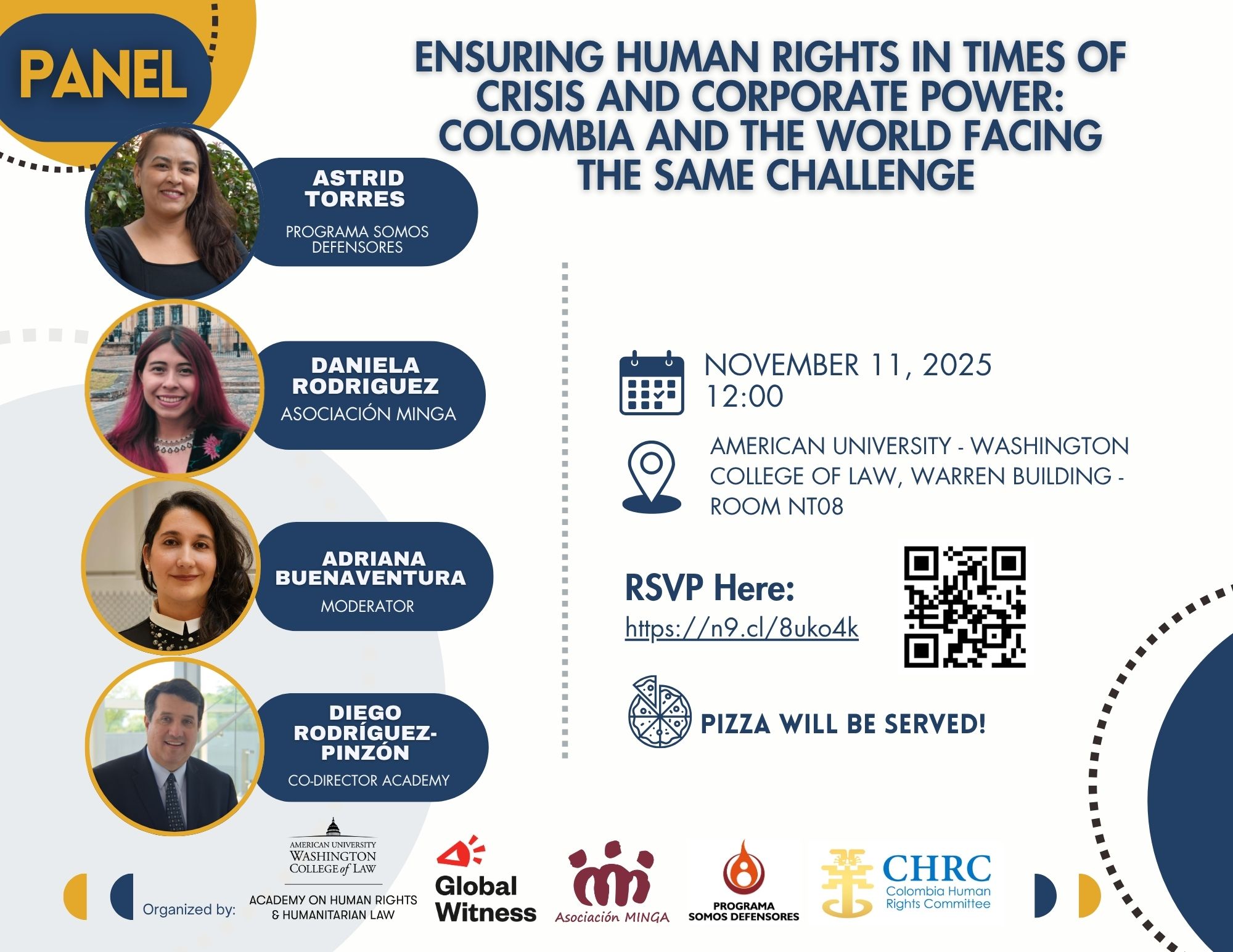
- Astrid Torres Ramírez, a human rights defender with over two decades of experience in civil society organizations. She has worked at the Sumapaz Foundation (2001–2011), the Semillas de Libertad Human Rights Collective (2003–2010), and the Corporación Jurídica Libertad (2015–2023), where she served as a researcher and professional within teams focused on guarantees for human rights defense, peacebuilding, and advocacy at national and international levels. Since January 2024, she has been the Program Coordinator of Somos Defensores.
- Daniela Rodríguez Novoa, a lawyer from the National University of Colombia, is a specialist in legal-penal institutions with experience in transitional justice and assistance to victims of the armed conflict. Since 2022, she has been affiliated with Asociación Minga, a human rights organization.
Opening remarks were delivered by Professor Diego Rodríguez-Pinzón, Co-Director of the Academy, and the session was moderated by Adriana Buenaventura-Martínez, Deputy Director of the Academy.
The event was co-sponsored by Global Witness, Asociación Minga, the Somos Defensores Program, and the Colombia Human Rights Committee (CHRC), and featured simultaneous Spanish–English interpretation.

- Main Challenges for the Defense of Human Rights
The conversation began with a broad reflection on global trends shaping the current landscape of risks faced by human rights defenders.
Astrid Torres emphasized that these risks must be understood within a “planetary crisis” marked by deep inequalities between the Global North and South, the inefficacy of international protection mechanisms—particularly regarding the right to life—the rise of regressive fundamentalist discourses, and the reduction of international cooperation resources, now largely oriented toward security and militarization agendas. She stressed the urgent need to “rescue human rights and the spaces that protect their defense.”
Daniela Rodríguez added that the lack of justice and the criminalization of social protest exacerbate the risks faced by defenders. She highlighted troubling setbacks, such as the amnesty law in Peru and the high levels of impunity in Colombia, especially in cases involving human rights violations linked to the armed conflict. She also noted that extractive companies are intensifying their political and legal pressure to reduce regulations, increasing the vulnerability of affected communities.
2. The Situation of Human Rights Defenders in Colombia and Constitutional Court Ruling SU-546 of 2023
The dialogue also addressed the impact of the Unification Ruling SU-546 of 2023, issued by the Constitutional Court of Colombia, in which the Court declared a structural failure, a widespread violation of fundamental rights, and an unconstitutional state of affairs concerning the protection of human rights defenders. The ruling ordered the State to design a comprehensive protection plan, emphasizing the special vulnerability of Indigenous and peasant communities and the obligation to adopt measures with an ethnic and territorial approach.
Daniela Rodríguez noted that while the ruling unified precedents and holds great potential as a protective tool, its effectiveness depends on institutional will. She pointed out that many of the orders have been delayed or remain unfulfilled, and that risks are particularly high in territories where fossil fuel extractive companies operate and resist energy transitions.
Astrid Torres added that no Latin American country is fully guaranteeing the right to defend human rights and that international reports show an alarming deterioration. She indicated that lethal violence against defenders increased by 20% in 2025, and that persistent impunity allows both legal and illegal armed actors to continue operating with broad freedom. While she recognized normative progress by the Colombian government in promoting dialogue and new protection tools, she emphasized that the implementation of SU-546 remains at “medium to low” levels and requires greater State urgency.
3. Corporate Power, Territory, and Community Protection
In the third part of the discussion, participants examined the impact of corporate power on human rights and the risks faced by communities and defenders in the context of large-scale economic projects.
Astrid Torres recalled the case of AngloGold Ashanti in Antioquia, Colombia, where peasant and Indigenous communities have faced threats and violence for opposing mining exploitation. She noted that in Colombia, “those who oppose a megaproject always end up threatened or killed,” illustrating how corporate pressure can shape State behavior and leave communities unprotected.
Daniela Rodríguez added that environmental defenders also face unfounded criminal proceedings aimed at silencing their work. She highlighted that in resource-rich areas, there is a clear correlation between the presence of corporations, illegal armed actors, and the confinement of populations to facilitate economic interventions. She further noted that sectors of the security forces often support corporate interests and that some companies foster internal divisions within communities to weaken grassroots organizational processes.