
CEJIL and GQUAL Urge the Inter-American Court to Recognize Parity as a Standard of Representative Democracy

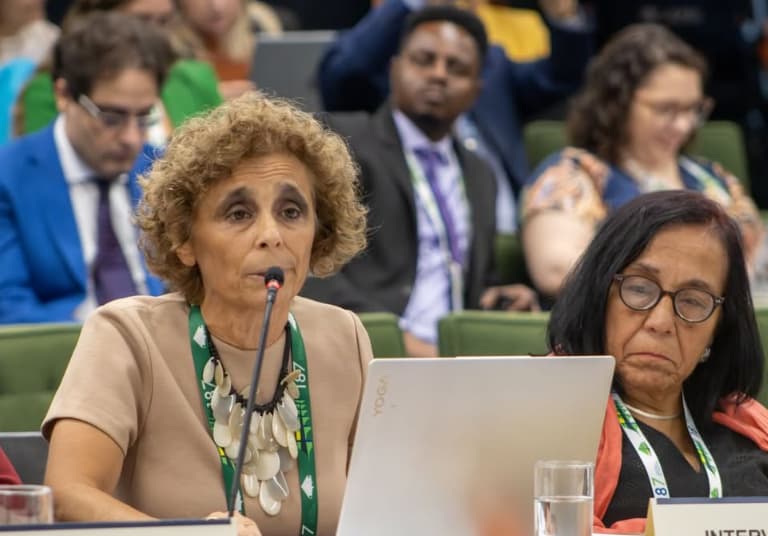
In the context of the request for an Advisory Opinion on democracy and its protection within the Inter-American Human Rights System (IAHRS), submitted by Guatemala before the Inter-American Court of Human Rights (IACtHR), the Center for Justice and International Law (CEJIL), the GQUAL Campaign, and the Academy on Human Rights at AUWCL Co-Director, Professor Claudia Martin, participated in public hearings on March 19, 2026, to urge the Court to recognize gender parity as a structural, permanent, and enforceable component of representative democracy under applicable Inter-American human rights standards. The hearings were held in Brasília, Brazil, as part of the Court’s 187th period of sessions.
The Inter-American normative framework - including the Inter-American Democratic Charter, the American Convention on Human Rights, and the jurisprudence of the Inter-American system - has established key standards for the protection of democracy as a guarantee of fundamental rights and has affirmed the centrality of equality and non-discrimination. However, the Court has not yet systematically developed the relationship between democracy, substantive equality, and gender parity. This gap limits the full realization of democratic principles in the region and leaves unresolved the extent to which equal participation must be reflected in the actual distribution of political power.

Despite these normative advances, women remain persistently underrepresented across decision-making spaces in the region. This underrepresentation constitutes one of the most significant democratic deficits in the Inter-American system. It does not reflect a lack of merit or capacity, but rather structural patterns of discrimination, institutional barriers, and entrenched practices that have historically limited women’s effective access to power. From this perspective, the right to political participation cannot be satisfied through formal recognition alone; it requires conditions that ensure genuine and effective representation of society as a whole.
In their amicus curiae brief, CEJIL and GQUAL argued that the right to public and political participation on equal terms, together with equality before the law, are structural elements of democracy. Building on this premise, they contend that parity - understood as a 50/50 distribution of power - constitutes the necessary expression of substantive equality in political participation and must therefore be recognized as a constitutive component of the right to democracy. This approach aligns with developments within the Inter-American system, evolving State practice in the region, and international standards, particularly General Recommendation No. 40 of the CEDAW Committee. Within this framework, parity should be understood not as a temporary corrective measure, but as both a baseline requirement and a permanent standard applicable to the design and functioning of democratic systems.

An Advisory Opinion recognizing parity in these terms would contribute to the progressive development of Inter-American law and strengthen democratic governance in the region. It would clarify that democracy cannot be considered fully realized in the absence of real equality in the exercise of political power. Based on these considerations, CEJIL and GQUAL requested that the Inter-American Court recognize gender parity as a structural component of representative democracy, affirm that it derives from the rights to substantive equality and political participation, and clarify the obligations of States to adopt concrete measures to achieve it, as well as the legal consequences of non-compliance.
Conclusion:
In light of these considerations, the recognition of gender parity as a structural component of representative democracy is essential to ensuring the effective realization of equality and political participation under Inter-American law. Without such recognition, democratic systems in the region will continue to reflect structural exclusion rather than genuine representation. The Advisory Opinion thus presents a critical opportunity for the Court to affirm that democracy cannot be fully realized in the absence of equal participation in the exercise of power.
You can learn more about the Inter-American Court’s 187th period of sessions here.
You can learn more about the Inter-American Court’s work here.
You can learn more about the Advisory Opinion requested by Guatemala regarding an autonomous right to democracy here.
You can learn more about GQUAL and CEJIL’s involvement in this process here.
Read the full amicus brief here.
Watch the hearing recording here - start at 3:39:40.