Washington College of Law logo
 
American University logo
Clinical Program
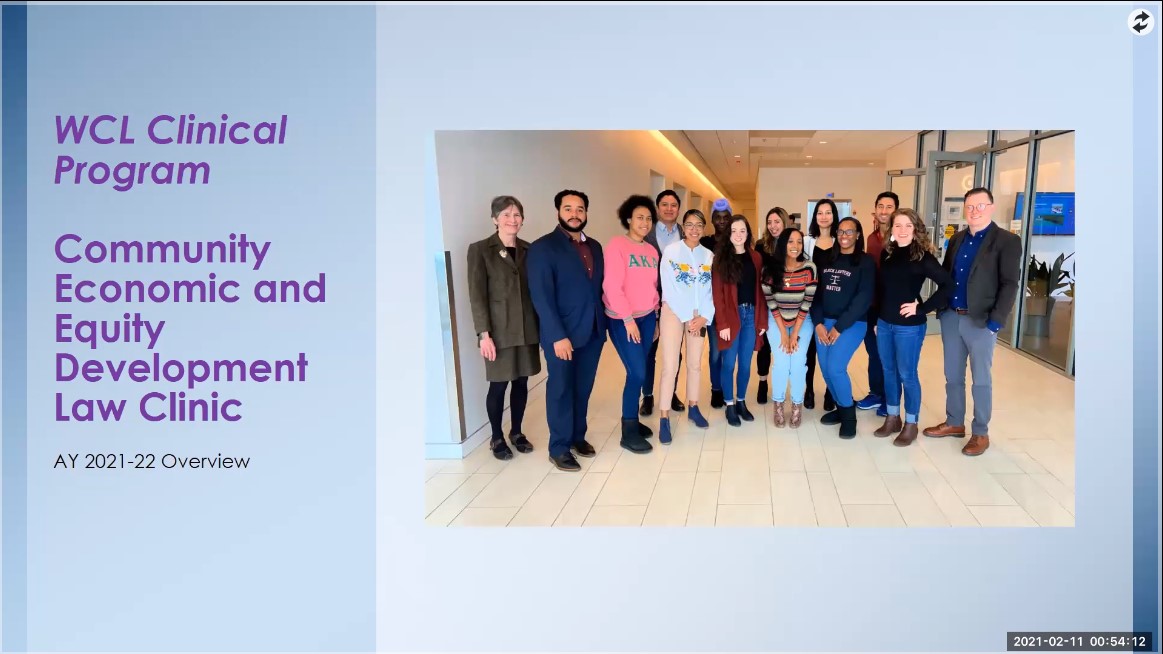
COMMUNITY AND ECONOMIC DEVELOPMENT LAW CLINIC
Program in Community Development and Transactional Law


  The Community and Economic Development Law Clinic (CEDLC) provides transactional legal services for client groups engaged in neighborhood-based community development. The clinic represents and helps organize small non-profits and businesses, and tenants’ associations in the public and private housing sectors, all of whom share the goal of developing resources for greatly underserved urban communities. The clients come to the clinic not so much with “problems” as with “projects:” how to buy and manage an apartment building to keep it inhabitable and affordable; how to decide between functioning as a non profit or a for profit organization; how to create community lending institutions for people who cannot afford to use banks; or how to run a farmer’s market to keep high quality fresh produce in a neighborhood without supermarkets. Each case encourages student attorneys to collaborate with clients as partners to reclaim for themselves the neighborhoods that government and planners have written off. Above all, the clinical experience enables student attorneys to examine the ethical and social change issues involved in group transactional representation as an innovative approach to poverty law practice.

This kind of representation involves extensive training in a wide array of transactional, business lawyering activities. Our clients’ projects require student attorneys to develop facility in interviewing, drafting, counseling, negotiating and problem-solving skills, as they translate their clients’ visions into articles of incorporation or organization, by-laws, applications for recognition of tax exempt status, and contracts for services. Students help clients decide what the most effective case presentation and forum for presenting it might be: whether that means the students arguing the client’s case in front of the Board of Zoning Adjustment, or the client board members themselves testifying at an agency oversight hearing. Student attorneys also learn that all good lawyers work in coalitions and pay attention to political developments. All our client work takes place in the context of extensive contact with other organizations that advocate for resources for city residents. Student attorneys have worked on many collaborative community projects. They have joined with other advocates for affordable housing to prepare clients to testify on proposed changes to admissions criteria for public housing, and have been sponsored by a community development corporation in presenting a series of seminars on incorporation and tax exempt status. Students helped one client organize a coalition of tenants’ co-ops to write and testify on behalf of legislation to make assessment of property taxes more equitable for affordable housing properties.

The clinic is open to 2Ls and 3Ls and is a two semester (fall-spring) program. Student attorneys must plan on attending a two to three day orientation to be held either before or during the first week of classes. In preparation for orientation, student attorneys will receive extensive readings and exercises to complete over the summer. While student attorneys should plan to devote an average of at least 20 hours per week to their clinic work, they should anticipate that, during some weeks, their clients’ cases will require a more intense commitment of time.

Faculty


Washington College of Law  -  4801 Massachusetts Avenue, NW  -  Washington, DC 20016  -  202-274-4000