
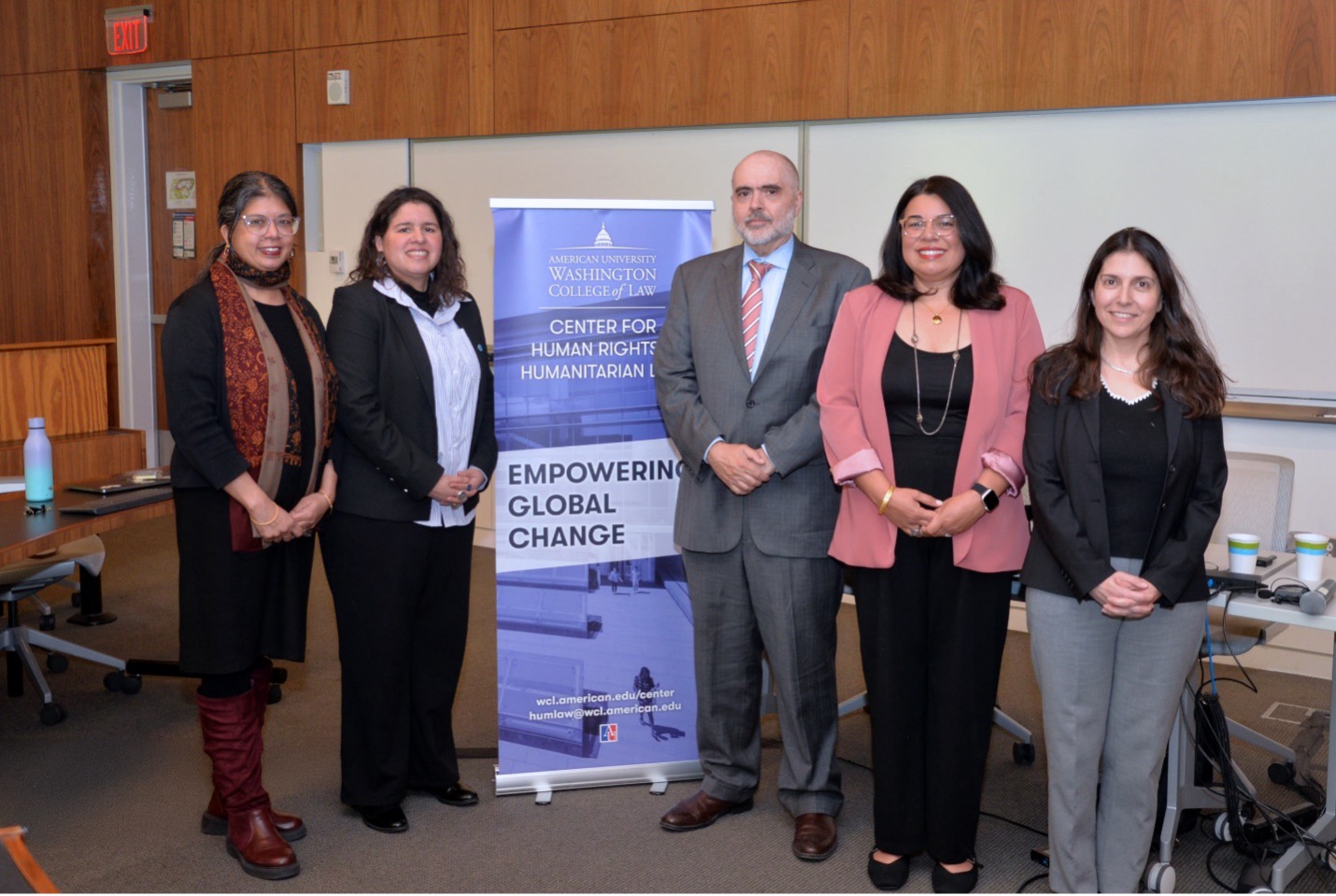
The Center for Human Rights & Humanitarian Law and the Program on Gender, Theory, Law & Practice at (AUWCL) hosted an impactful discussion on Tuesday, April 8, 2025 addressing the urgent challenges facing women's rights globally. The event, titled "Women’s Rights in the Face of Democratic Erosion: Resisting Authoritarianism and Defending Human Rights," brought together leading voices in the field to share their experiences and strategies for advocacy in the face of growing authoritarianism.
Distinguished Panelists Included:
- Macarena Sáez, Executive Director, Women’s Rights Division, Human Rights Watch
- Carolina Jiménez Sandoval, President, Washington Office on Latin America (WOLA)
- Amanda Baran, Adjunct Associate Professor, AUWCL
The discussion was skillfully moderated by Professor Anita Sinha, Director of the International Human Rights Law Clinic and Faculty Director of the Program on Gender, Theory, Law & Practice at AUWCL.
Key themes & panelist contributions
Macarena Sáez: The Gendered Face of Contemporary Authoritarianism
Macarena Sáez opened by framing today’s authoritarianism as distinct from that of the 20th century. Unlike previous eras, modern authoritarianism often emerges through democratic institutions, with citizens electing leaders who then undermine those very systems. She cited El Salvador, Argentina, and Hungary as examples of this phenomenon, where elected leaders dismantle judicial independence, persecute opponents, and restrict freedom of expression.
A central theme in her remarks was the targeted rollback of women’s rights. Sáez argued that contemporary authoritarianism positions gender and sexuality as existential threats to the nation, leveraging narratives around "protecting the family" and "parental rights" to curtail autonomy and equality. Reproductive rights, gender identity, and non-normative sexualities are recast as dangers to national identity.
She warned that authoritarian regimes across the ideological spectrum—from Vladimir Putin (Russia) to Nayib Bukele (El Salvador) to Javier Milei (Argentina)—share a moral and cultural ideology that targets gender equality. These leaders strategically deploy human rights language to justify regressive policies, reframing anti-abortion or anti-LGBTQ+ stances as protective rather than repressive. Sáez stressed the urgent need to reclaim the narrative of human rights and challenge the passivity of the public, which often allows authoritarianism to take root unchallenged.
Carolina Jiménez Sandoval: Latin America's Paradox of Power and Repression
Carolina Jiménez Sandoval contextualized the rise of authoritarianism in Latin America as a deeply patriarchal phenomenon, rooted in machismo and a legacy of strongman “caudillo” leadership. Authoritarian figures in the region—whether from the right or left—often embrace traditional masculinities and religious conservatism, portraying themselves as defenders of morality and order.
Yet, Latin America is also home to one of the world’s most vibrant feminist movements, particularly around reproductive rights. It is precisely because these movements have become powerful political actors, she explained, that they are increasingly targeted. Regimes dismantle institutions like women’s ministries and coopt feminist language to legitimize their control. For example, leftist regimes in Cuba and Venezuela proclaim themselves as feminist, even while fragmenting or weakening actual protections for women.
She expressed deep concern about the normalization of authoritarianism through democratic legitimacy, citing high approval ratings for leaders like Nayib Bukele. Disinformation, the growth of the manosphere, and digital attacks on feminist voices present new challenges. Still, she emphasized that feminism in Latin America remains a vital force for democratic renewal and collective reflection on the rule of law.
Amanda Baran: U.S. Policy, Migration, and Women’s Rights under Threat
Amanda Baran turned the focus to the United States, highlighting how immigration enforcement has increasingly become a site for authoritarian practices—especially targeting migrant women. Drawing from her experience at USCIS and DHS, she noted how policies once designed to provide safe spaces (such as hospitals or shelters) have become hostile environments under growing domestic surveillance and militarization.
Baran discussed the gendered impact of these policies, including increased vulnerability to gender-based violence, fear of reporting abuse, and lack of access to reproductive and health care services. Detention centers have expanded, and even executive orders around citizenship have created fear among women seeking protection for themselves and their children.
She underscored how laws are being used to justify discriminatory practices—echoing Sáez’s warning about the cooptation of human rights discourse. Yet, Baran also spotlighted signs of resistance: local communities organizing, calling members of Congress, and advocating for policy change. She called for continued vigilance and coalition-building to protect immigrant women’s rights in the face of rising authoritarianism.
Conclusion
The panel offered a sobering but urgent analysis: the rollback of women’s rights is not a byproduct of authoritarianism—it is often its blueprint. Across the globe and in the Americas, authoritarian leaders deploy moral and cultural narratives to legitimize control, and women's bodies, voices, and rights are often the first battleground.
Yet, the panel also illuminated hope. From Latin America’s feminist uprisings to grassroots resistance in the U.S., movements for gender justice are also movements for democracy. The conversation closed with a call to reclaim human rights language, strengthen intersectional coalitions, and expand civic education that connects democracy to everyday life—particularly for women and marginalized communities.