| INTERNATIONAL HUMAN RIGHTS LAW CLINIC Asylum Cases, Human Rights Cases and Projects and Immigrants’ Rights |
|||||||
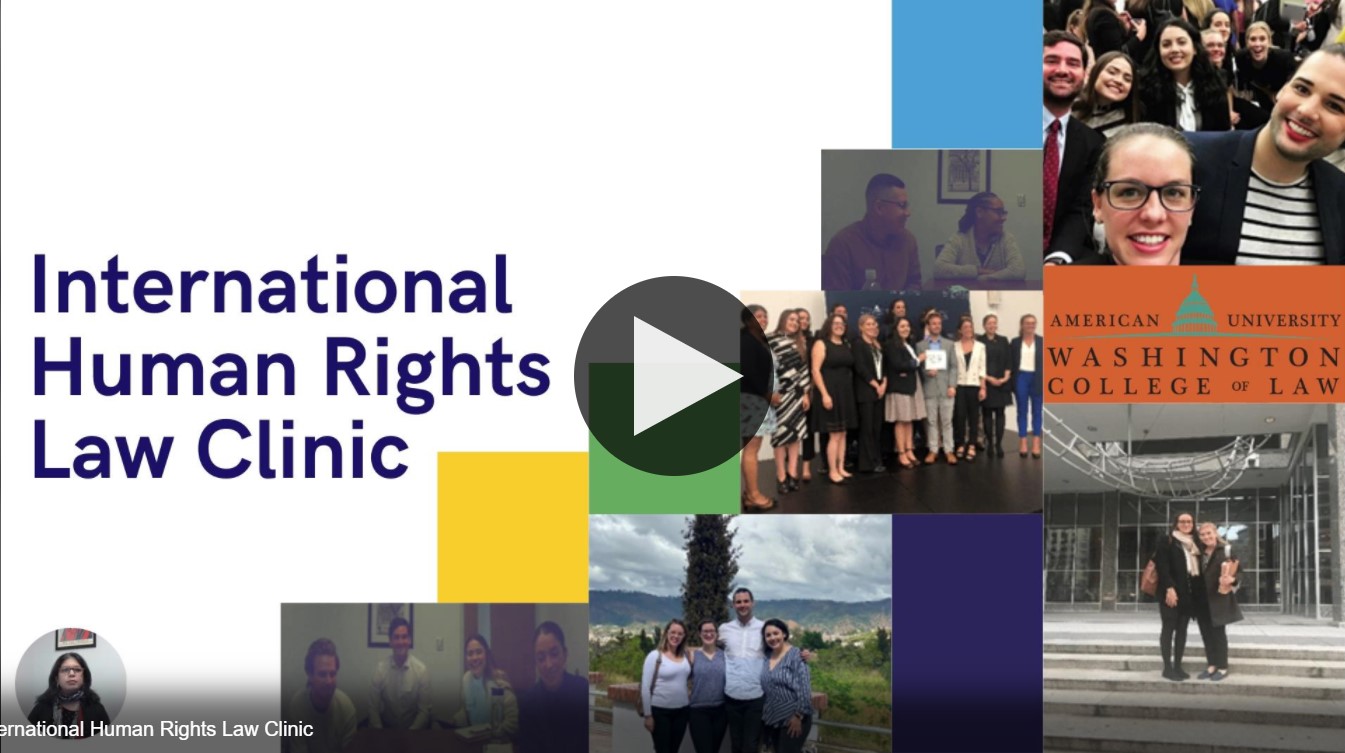
The International Human Rights Law Clinic offers student attorneys the opportunity to represent individuals, families or organizations alleging violations of recognized or developing human rights norms before international and domestic judicial bodies. The clinic features two sections: a General Human Rights Section, and one that is focused more specifically on Immigrants’ Rights.
The General Human Rights Section (GHR) provides representation in two types of cases: international human rights cases and projects and political asylum cases. In the human rights area, student attorneys draft pleadings and other submissions, present evidence, witnesses and arguments in oral proceedings, and often will struggle with issues of client contact and fact gathering over long distances with difficult means of communication. Student attorneys have represented clients in cases before the Inter-American Human Rights Commission, the African Commission on Human Rights, United Nations human rights treaty bodies, the U.S. Court of Appeals for the Fourth Circuit and the Armed Forces, and U.S. District Courts and currently represents one of the detainees at Guantánamo Bay, Cuba in federal court. Student attorneys also work on projects to influence U.S. law and policy on human rights issues. The GHR Section also provides representation to refugees seeking asylum in the U. S. as a result of political persecution in their countries of origin. Student attorneys meet and counsel clients and their families and appear as counsel in hearings and appeals at which they introduce evidence, call witnesses and present oral and written arguments on behalf of their clients. In past academic years, student attorneys have obtained asylum for clients from Sierra Leone, Angola, Somalia, the Democratic Republic of Congo, China, Ethiopia, Guatemala and Cameroon, to name some of the countries with which we work. The Immigrants’ Rights Section (IR) provides representation on a broad range of cases involving immigrant communities in the D.C. area. These include cases of exploited low-wage immigrant workers (e.g., domestic workers, restaurant workers and day laborers) including trafficked individuals, asylum and non-asylum immigration cases, and language rights cases. While some of these cases involve immigration, many more reside at the intersections of immigration, labor, and criminal law, and often have a transnational dimension. Cases are brought in federal district court, in the courts of Maryland and D.C., in Immigration Court, and before federal and state agencies. Student attorneys work with individual clients and client groups, and gain exposure to immigrant organizing efforts and immigrants’ rights policymaking in the DC area. Cases and projects in 2006-07 included the representation of several detained immigrants, the representation in federal court of immigrant domestic workers, and the drafting of legislation regarding language access to social services in the District of Columbia. Each section also features a seminar which meets once each week for two hours, followed by one hour of case rounds, for a total of three hours of class each week. Student attorney teams of two meet at least every other week with their supervising attorney to discuss their cases. The course focuses on lawyering skills, ethical issues and preparation for the practice of law. Teaching methods are experiential and student-focused including extensive use of simulation and role-playing exercises. Additionally, some time is devoted to issues of the role of attorneys in social change and long-term professional satisfaction. Summer reading and orientation either the week before classes start or during the first weekend of the fall are required parts of the curriculum. |
|
||||||